


PROCEDURES
FOR FOREIGN INVESTORS TO ESTABLISH ENTERPRISES IN VIETNAM
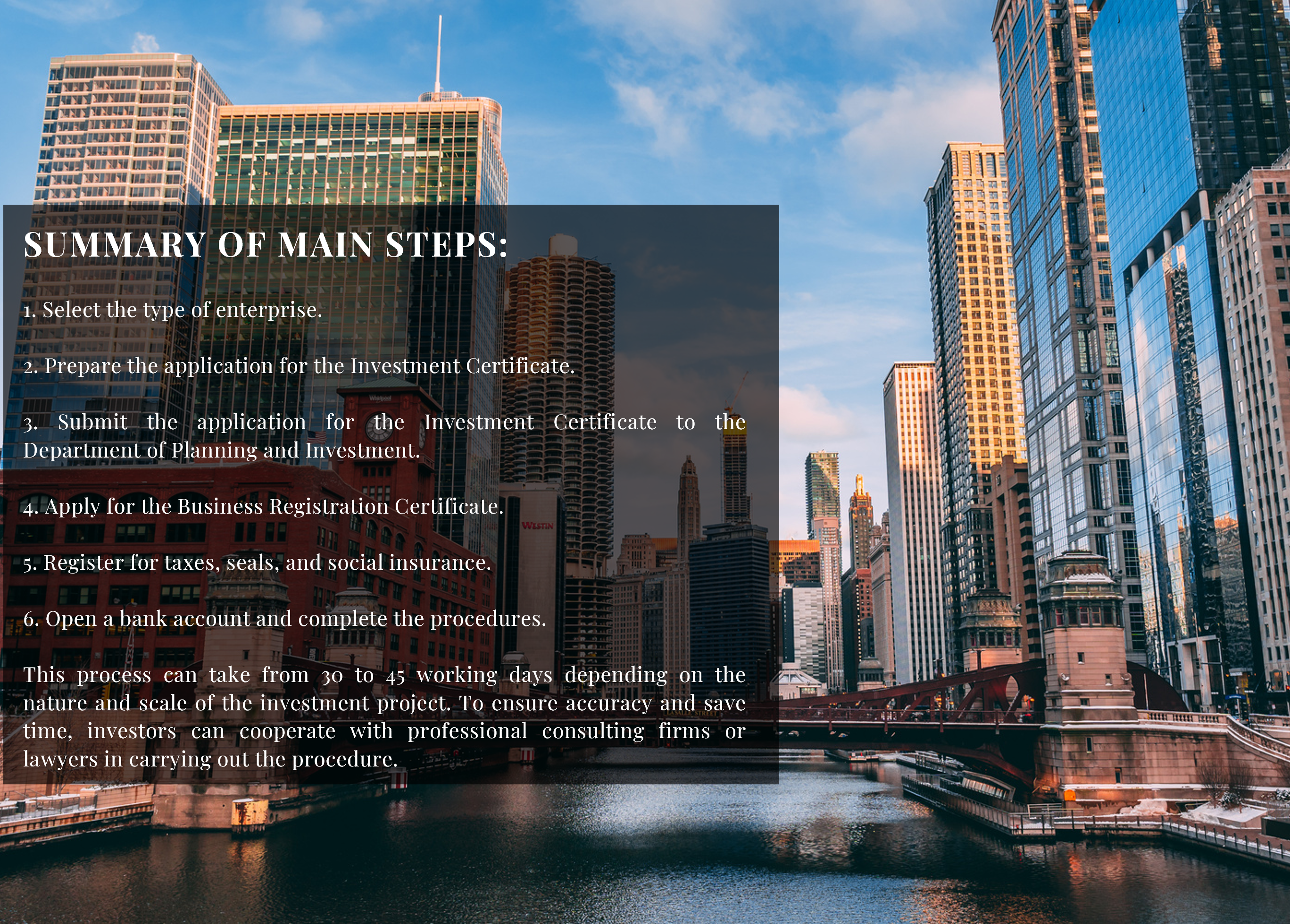
Establishing a business in Vietnam requires foreign investors to comply with a number of quite specific legal procedures and processes. These processes may vary depending on the type of business the investor wants to establish (for example: LLC, JSC, branch, representative office, etc.).

DETAILS OF THE MOST BASIC STEPS
1. Research and choose the type of business
Foreign investors need to determine the type of enterprise that suits their business goals. Common types of enterprises that foreign investors can establish in Vietnam include:
• Single-member LLC: A company with only one owner (can be an individual or a foreign organization).
• LLC with two or more members: Has from 2 to 50 capital contributing members, which can include foreign investors.
• Joint-stock company: A company can have from 3 shareholders or more, in which shareholders can be individuals or foreign organizations.
• Branch, representative office: Suitable for investors who want to operate in Vietnam but do not want to establish a complete company.
2. Evaluate investment potential and research investment areas
• Investors should carefully study the regulations on business sectors that can be invested in Vietnam. Some sectors may be restricted or prohibited for foreign investors (e.g. national security, environment, health, defense, etc.).
• In addition, it may be necessary to assess the maximum percentage of ownership that a foreign-invested company can have in certain sectors (e.g. telecommunications, financial services, etc.).
3. Prepare application for Investment Certificate
Application for Investment Certificate is the first step when investors want to establish a business in Vietnam.
The dossier includes:
• Application for Investment Registration Certificate (according to the form of the competent authority).
• Financial report (if the investor is an organization).
• Introduction to the investment project, including description of the industry, investment scale, charter capital, business project and project implementation progress.
• Copy of passport, Certificate of legal entity of the investor (if an organization) or identification document (if an individual).
• Power of attorney (if there is a legal representative submitting the dossier).
• Copy of office lease contract, contract related to land and premises use (if any).
• Financial plan or investment capital plan.


4. Submit application for Investment Certificate
• The application is submitted to the Department of Planning and Investment (DPI) of the province or city where the investor wants to establish the enterprise.
• The state agency will review and issue the Investment Registration Certificate within 10 to 15 working days (depending on the complexity of the application).
5. Carry out business registration procedures
After obtaining the Investment Certificate, the investor continues to register the business at the Department of Planning and Investment where the head office is planned to be located. The steps include:
• Apply for a Business Registration Certificate: This is the basic procedure to officially establish a company.
• Registering the company seal: After obtaining the Business Registration Certificate, the company needs to make a seal and register the seal sample with the police agency (PC64 department).
• Registering taxes and tax codes: The company needs to register a tax code with the tax agency to operate legally in Vietnam.
6. Other related procedures
• Open a bank account: After the company is granted a Business Registration Certificate and a tax code, the investor needs to open a corporate bank account to conduct financial transactions.
• Register with the social insurance agency: If there are employees working at the company, the company needs to register to participate in social insurance and health insurance for employees.
7. Receive Certificate and complete procedure
After completing the above steps, the company will receive a Certificate of Business Registration, and can legally start doing business in Vietnam..
Noted when foreign investors establish businesses in Vietnam:
1. Minimum investment capital: Some industries require investors to have a minimum investment capital (for example: real estate, banking, etc.).
2. Ownership: Depending on the industry and type of business, foreign investors can own from 0% to 100% of shares in the business.
3. Joint venture company: If a joint venture company is established (with a Vietnamese partner), the ownership ratio of foreign investors will be limited by law.
4. Taxes and financial obligations: Newly established companies need to pay attention to taxes and financial obligations such as corporate income tax, VAT, personal income tax, social insurance…


FOREIGN DIRECT INVESTMENT
(FDI) COMPANY
ESTABLISHMENT SERVICE
IN VIETNAM
Are you a foreign investor who wants to open a company in Vietnam but don’t know where to start? We specialize in providing FDI company establishment services in Vietnam, supporting from investment registration to complete legal procedures, helping you quickly put your business into operation.

IFRS AUDIT COMPANY PROVIDE FOR YOU
• Free advice on investment industry
• Fast and accurate legal procedures
• Ensure compliance with Vietnamese laws
Contact us to start your investment journey in Vietnam!
Benefits of choosing our FDI company establishment service:
• Detailed advice on investment regulations and industries allowed for investment in Vietnam.
• Full legal support, helping investors save time and effort.
• Full service from initial consultation, legal documentation, tax registration, to support in opening bank accounts and financial obligations.
• A team of experienced experts, knowledgeable about Vietnamese law and regulations of foreign investors.


IFRS Auditing and Consulting Company Limited
The company provides a wide range of services such as audit of financial statements, tax advice, accounting services and valuation services with leading experts working in large auditing firms, multinational corporations


