

CONTENTS
1. What is FDI Enterprise Accounting?
2. What Skills Are Required for Accounting in FDI Companies?
3. Accounting Tasks in FDI Companies
4. Experience in Accounting for Foreign Companies
5. Accounting Salaries for Foreign Companies



1. WHAT IS FDI ENTERPRISE ACCOUNTING?
FDI enterprise accounting (Foreign Direct Investment) is the accounting process applied in companies with foreign direct investment in a country. When a foreign company invests in a business in another country, FDI accounting involves recording and reporting the company’s business activities in compliance with international accounting principles and standards.
FDI accountants frequently deal with issues such as transfer pricing, exchange rates, taxes, and related legal matters. Their work may also include monitoring and reporting on the transfer of funds between the parent company and its subsidiaries/branches in different countries.
The goal of FDI accounting is to provide accurate and transparent financial information about the FDI company’s operations to stakeholders, including the government, shareholders, banks, and investors.
FDI accounting information may also be used to evaluate investment efficiency and manage risks in an international business environment.


Characteristics of FDI Enterprise Accounting
FDI enterprise accounting has certain specific characteristics compared to domestic company accounting. Some key points to consider include:
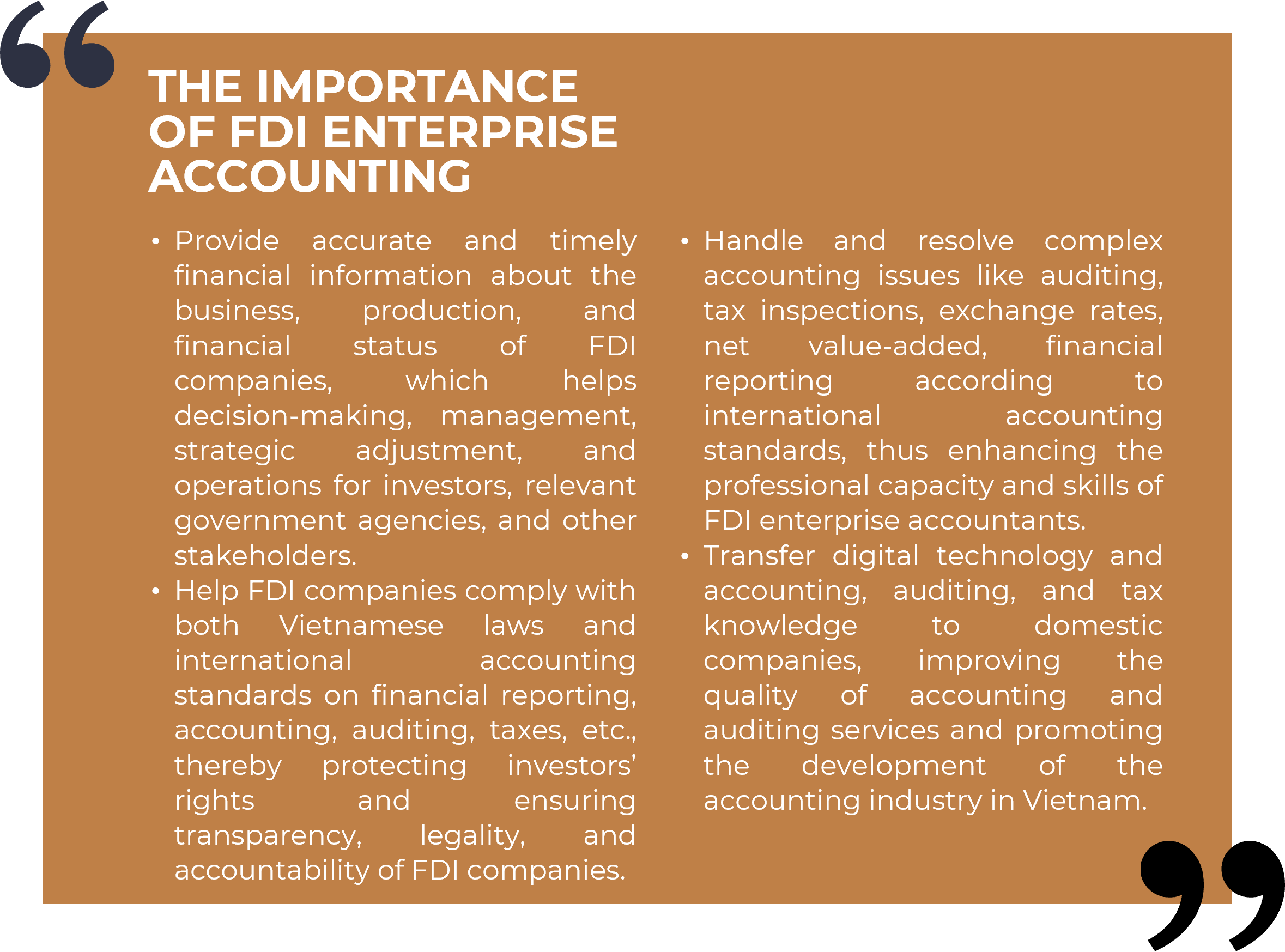
• Legal Regulations: FDI companies must comply with both the accounting regulations of their home country and the host country. This requires a thorough understanding of accounting laws, taxes, and related rules in both jurisdictions.
• Currency: FDI companies often operate in multiple currencies, which creates exchange rate risk. Accountants must handle currency conversion, revaluing amounts, and reporting in a common currency.
• Tax Reporting: FDI companies must comply with tax laws in both the home and host countries. Accountants must prepare detailed tax reports for both sides.
• Transfer Pricing: In FDI companies, transfer pricing plays an important role. Accountants must ensure that transactions between subsidiaries, branches, or joint ventures are conducted according to reasonable transfer pricing principles and in compliance with regulations in both countries.
• Financial Reporting: FDI companies need to prepare financial statements according to international accounting standards (IFRS) or domestic standards, depending on the requirements of each country.
• Auditing: FDI companies may be subject to auditing requirements in both countries. This requires an understanding of auditing standards and laws in each country. Each FDI company may have specific characteristics based on industry, business model, and legal requirements in each country. Vietnam has enacted the Law on Foreign Investment to regulate the activities of FDI companies, including accounting regulations
What is needed to work as an accountant for a foreign company?
FDI enterprise accounting is a vast and complex field requiring deep knowledge of legal regulations, accounting standards, and business practices. FDI accounting not only helps companies comply with legal requirements but also optimizes business efficiency and increases competitive advantage. To work as an accountant for an FDI company, you need the following knowledge and skills that are often requested by employers:
– Knowledge of International Accounting and Related Regulations: You must have a solid understanding of international accounting standards (IAS and IFRS), as well as practices such as report preparation, bookkeeping, tax calculation, social insurance, auditing, etc.
– Knowledge of Vietnamese Accounting and Related Policies: Even though it’s an FDI company, it operates in Vietnam and must comply with Vietnamese accounting standards. You should understand how to prepare financial statements, accounting records, tax filings, salary calculations, etc., for a foreign company according to Vietnamese accounting standards.

– Skills in Calculation and Using Accounting Software: You need good calculation skills, accuracy, and sensitivity when working with numbers. With the growing trend of digital technology, proficiency in IT and accounting software is becoming increasingly important. Some popular accounting software includes MISA, FAST, etc.
– International Accounting and IT Certifications: You should hold at least one international accounting certification like CPA, ACCA, CMA, CIA, CFA, etc., to demonstrate your professional capability and ability to work in an international environment. These certifications help improve knowledge, skills, communication abilities, and collaboration with both domestic and foreign stakeholders, increasing job opportunities and income.



The job of an FDI enterprise accountant involves gathering documents, processing, recording business transactions, checking, analyzing, and reporting on the financial, business, and tax information of the FDI company.
Key tasks include:
– Managing the company’s revenues and expenses, including:
• Collecting money from customers, suppliers, and shareholders.
• Paying suppliers, employees, taxes, and banks.
• Reconciling accounts payable and receivable.
• Resolving exchange rate issues.
• Managing expenses related to operations, production, and business activities.
• Setting up provisions for exchange rate differences, bad debts, and unrecoverable debts.

– Preparing and filing tax reports according to both Vietnamese and foreign tax regulations, including:
• Declaring and paying VAT, corporate income tax, personal income tax, import/export taxes, etc. Reviewing tax incentives for FDI companies in Vietnam, such as tax exemptions or reductions.
• Reconciling with free trade agreements to prevent double taxation.
– Preparing and submitting financial reports as required by Vietnamese and foreign regulatory agencies, including income statements, cash flow statements, equity change reports, financial position reports, etc.
– Applying Vietnamese Accounting Standards and IFRS in bookkeeping and financial reporting; translating financial statements into the language of foreign investors.
– Carrying out other tasks related to FDI accounting, such as internal control, auditing, inspection, liquidation, and dissolution.




“TO GAIN EXPERIENCE IN ACCOUNTING FOR FOREIGN COMPANIES, YOU SHOULD:
• Study and improve your knowledge in accounting, taxes, language, and foreign corporate culture.
• Seek internship, part-time, or full-time opportunities at foreign companies or international accounting and auditing firms, with examples like the BIG4: Deloitte, Ernst and Young (EY), PwC, and KPMG.
• Participate in courses, certifications, and qualifications related to international accounting standards, as well as Vietnamese and international standards such as ACCA, CPA, CMA, CIA, CFA, etc.

• Join accounting forums, social media groups, and networks to exchange knowledge and expand connections.
• Attend FDI enterprise accounting courses at reputable centers.
• Stay updated on the latest information, regulations, and changes in Vietnamese and international accounting and tax laws.



Salaries for FDI enterprise accountants can range from 5 million VND to 80 million VND per month, depending on the position and level of experience. Specific salary ranges are as follows:
• Accounting Intern: 5 million VND to 15 million VND per month.
• General Accountant: 12 million VND to 25 million VND per month.
• Tax Accountant: 18 million VND to 30 million VND per month.
• Chief Accountant: 27 million VND to 80 million VND per month.



IFRS Auditing and Consulting Company Limited
The company provides a wide range of services such as audit of financial statements, tax advice, accounting services and valuation services with leading experts working in large auditing firms, multinational corporations


