




After 35 years, South Korea, Singapore and Japan are the three countries investing the most FDI in Vietnam, while US enterprises are outside the top 10. After the event of Vietnam – US upgrading diplomatic relations to a comprehensive strategic partnership, international media expected that Vietnam could welcome the 4th wave of FDI with the main capital flow from the world’s largest economy. What is your opinion on this issue?
Previously, foreign investment in Vietnam mainly came from Asian countries and territories such as Japan, Korea, Singapore, China,…
This shows that the world’s largest investors have not invested much in Vietnam. For example, the US currently invests about 300 billion USD/year abroad, at least 200 billion USD/year, but the US invests only 1 billion USD in Vietnam. If Vietnam attracts investment from superpowers such as the US and EU, the growth prospects for the economy are very high.
In 2023, there were positive signals in the flow of investment capital from the US, EU, etc. into Vietnam. This shows that Vietnam is a promising investment destination.

At present, we have a great opportunity, this opportunity can probably be done better, for the following reasons:
Firstly, Vietnam is an integrated country with many bilateral and multilateral FTAs (Free Trade Agreements), including the largest countries in the world. This is a favorable condition for Vietnam.

Second, Vietnam’s political and economic system is very stable, the investment environment and legal system have been continuously improved, our businesses have also developed strongly in recent times; human resources have also developed better in both quantity and quality.
Previously, we used tax tools to attract foreign investment in Vietnam, so many foreign-invested enterprises came to Vietnam, especially high-tech enterprises. There are FDI enterprises that are given tax priority, paying only 6-7% corporate income tax, while Vietnam’s corporate income tax floor is from 20-25%.
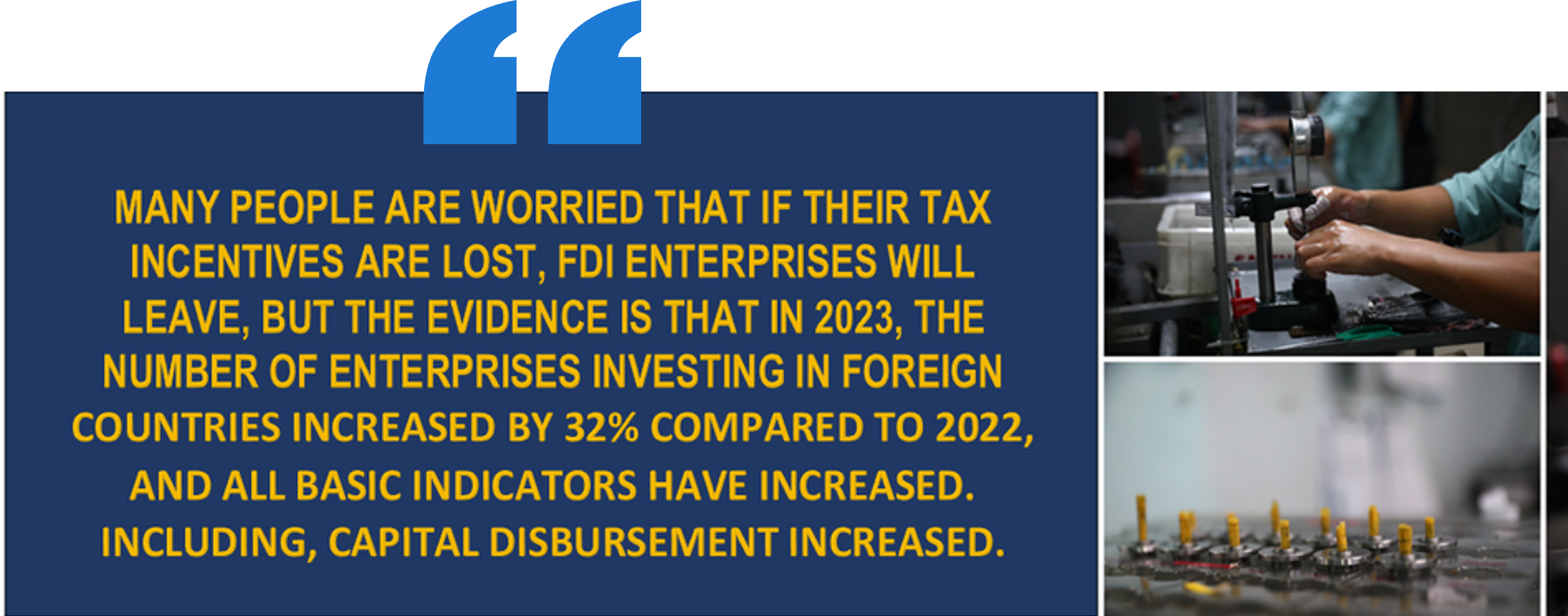
When Vietnam applies the Global Minimum Tax, FDI enterprises investing in Vietnam will no longer receive tax incentives, the tax rate will increase to 15% from 2024. Many people are concerned that if tax incentives are lost, FDI enterprises will leave, but the evidence is that in 2023, the number of foreign-invested enterprises in Vietnam increased by 32% compared to 2022, the basic indicators all increased, in which, capital disbursement increased.
This clearly shows that it is not only tax incentives that FDI enterprises “nest” in Vietnam, but we have many favorable conditions to attract FDI enterprises, from institutions, investment environment, to favorable conditions in human resources, resources…


That is, in addition to tax incentives, will FDI enterprises choose to invest in a country with a safe, favorable and stable environment for long-term investment?
The world is pivoting towards foreign investment. For example, when investing abroad, the US and EU always consider the possibility of long-term investment, not just trade (short-term investment). Long-term investment means that they “pour” resources to build factories, plants, establish companies, build ecosystems, etc.
Therefore, when the geopolitical and economic situation of the world changes, FDI enterprises must find a safe and friendly investment environment and Vietnam is such a destination.
Vietnam is currently a strategic partner of most of the strong countries in the world. These things have created strong confidence for FDI enterprises to invest. With the EU, we have an Investment Protection Agreement (IPA), which if implemented will create great confidence for EU investors.
In addition, Vietnam has very good capacity to develop the semiconductor industry. The evidence is that more and more US technology enterprises are coming to Vietnam. This shows that Vietnam’s role in the semiconductor industry chain is growing. Universities and leading training institutions such as ASU and Arizona are also expanding cooperation with the National Innovation Center NIC to support semiconductor human resource training.

However, in attracting foreign investment, there are still limitations such as the lack of connection between the FDI sector and domestic enterprises, and ineffective technology transfer. At the same time, Vietnam has not yet escaped the status of processing, what is your assessment of this issue?
That’s right, we do very well in attracting foreign investment, but the added value of our exported products is not high. This proves that we have not made good use of foreign investment in Vietnam to create high efficiency for the economy.
Therefore, in order to create high added value for Vietnam, we must strengthen the connection between the FDI sector and domestic enterprises and increase technology transfer. Because the connection between foreign investment enterprises and domestic enterprises has long been a weak link. Through this opportunity, we must make this a central issue, not just do it superficially.
There is an issue that FDI enterprises are very interested in, which is electricity. Each semiconductor chip factory needs about 100 MW of electricity, equivalent to an average power plant. In particular, the power source must be clean, renewable energy, not traditional, fossil energy. We must solve all these problems to become the world’s semiconductor chip manufacturing center.


IFRS Auditing and Consulting Company Limited
The company provides a wide range of services such as audit of financial statements, tax advice, accounting services and valuation services with leading experts working in large auditing firms, multinational corporations


