

ENHANCING FINANCIAL TRANSPARENCY
GOVERNMENT ISSUES
DECREE 90/2025/ND-CP
AMENDING GUIDELINES FOR
THE LAW ON INDEPENDENT AUDIT

On April 14, 2025, the Government officially promulgated Decree No. 90/2025/NĐ-CP, amending and supplementing several provisions of Decree No. 17/2012/NĐ-CP, which details and guides the implementation of the Law on Independent Audit 2011.

KEY UPDATES ON
INDEPENDENT AUDIT REQUIREMENTS
CONTENT:
1. Expansion of Audited Entities
2. Changes to Regulations on Audit Report Signing Deadlines
1. EXPANSION OF AUDITED ENTITIES
According to Article 15 of Decree 17/2012/NĐ-CP as supplemented by Article 1 of Decree 90/2025/NĐ-CP, the following entities are required by law to have their annual financial statements audited by an auditing firm or a branch of a foreign auditing firm operating in Vietnam:
Enterprises and organizations required by law to have their financial statements audited, including:
a) Enterprises with foreign investment;
b) Credit institutions operating under the Law on Credit Institutions, including branches of foreign banks in Vietnam;
c) Financial institutions, insurance companies, reinsurance companies, insurance brokers, and branches of foreign non-life insurance companies;
d) Public companies, issuers, and securities trading organizations;
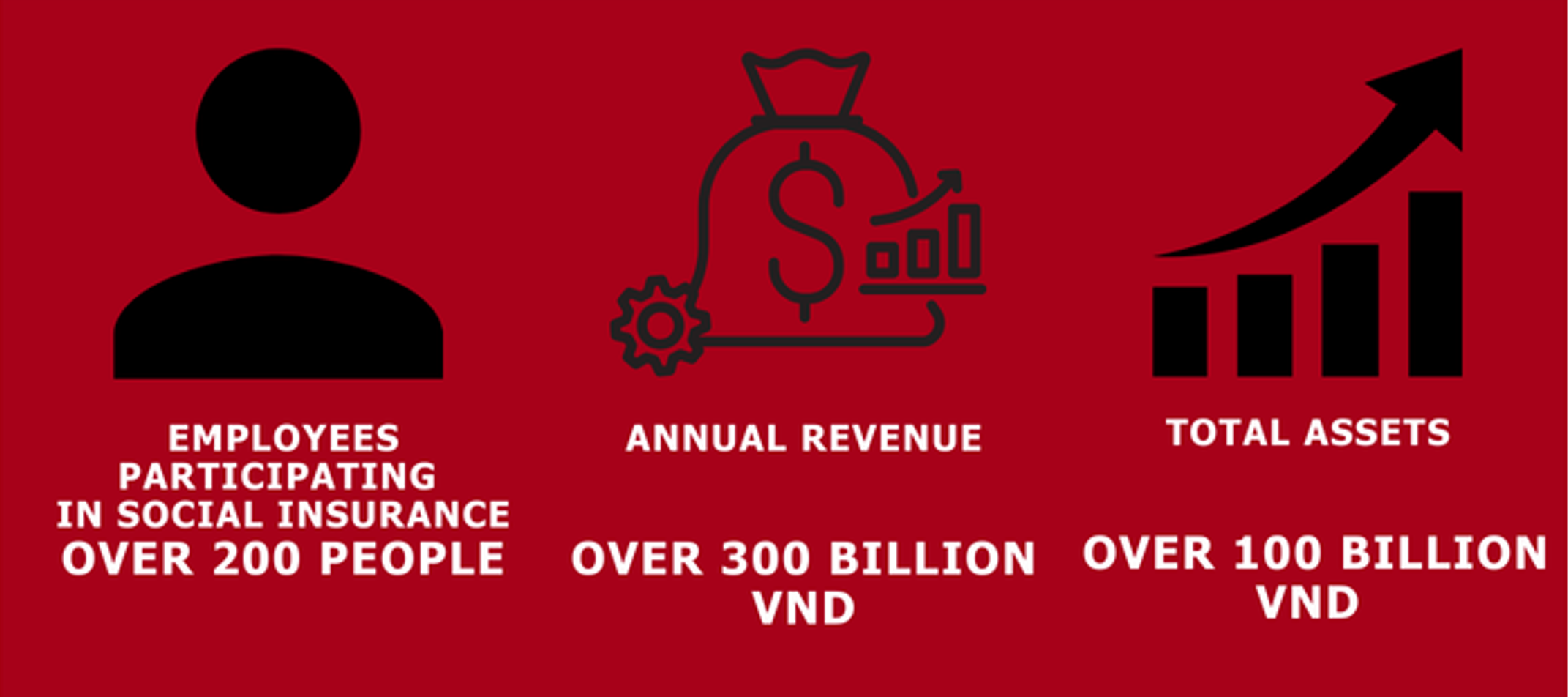
dd) Other large-scale enterprises that meet at least 2 out of the following 3 criteria (as defined in Article 37 of the Law on Independent Audit):
+ An average of more than 200 employees participating in social insurance;
+ Annual revenue exceeding VND 300 billion;
+ Total assets exceeding VND 100 billion.

2. Other enterprises and organizations required to be audited under relevant legal regulations.
3. Enterprises and organizations whose financial statements must be audited by an auditing firm or a branch of a foreign auditing firm in Vietnam include:
a) State-owned enterprises, except those operating in areas classified as state secrets under the law, must have their annual financial statements audited.
b) Enterprises and organizations implementing nationally important projects or Group A projects using state capital, except for those in fields classified as state secrets under the law, must have their completed project settlement reports audited.
c) Enterprises and organizations in which state-owned corporations or groups hold 20% or more of the voting rights as of the end of the financial year must have their annual financial statements audited.
d) Enterprises in which listed organizations, issuing organizations, and securities trading organizations hold 20% or more of the voting rights as of the end of the financial year must have their annual financial statements audited.
dd) Auditing firms and branches of foreign auditing firms in Vietnam must have their annual financial statements audited.

4. Enterprises and organizations subject to annual financial statement audits as stipulated in Clauses 1 and 2 of this Article, if required by law to prepare consolidated financial statements or combined financial statements, must have those consolidated or combined financial statements audited.
5. The auditing of financial statements and final accounts of completed projects for enterprises and organizations specified at Points a and b, Clause 2 of this Article does not substitute for audits conducted by the State Audit Office of Vietnam.
6. Other enterprises and organizations may voluntarily undergo audits.
7. In addition, this Decree provides specific guidance on the principles for determining the average annual number of employees participating in social insurance, the total annual revenue, and the total assets of the entities specified at Point đ, Clause 1, Article 15 of Decree No. 17/2012/NĐ-CP, as amended by Article 1 of Decree No. 90/2025/NĐ-CP, as follows:
•The number of employees participating in social insurance refers to all employees managed, employed, and paid wages or salaries by the entity who are enrolled in social insurance in accordance with the law on social insurance;
•The average annual number of employees participating in social insurance is calculated by dividing the total number of social insurance participants for all months of the preceding year by 12 months;
•The number of employees participating in social insurance for a month is determined at the end of that month, based on the social insurance payment documents submitted by the enterprise to the social insurance authority;
•Total annual revenue is determined based on the annual financial statement of the preceding year, prepared by the entity in accordance with the law on accounting;
•Total assets are determined at the end of the financial year based on the annual financial statement of the preceding year, prepared by the entity in accordance with the law on accounting.
8. Enterprises subject to the provisions at Point đ, Clause 1, Article 15 of Decree No. 17/2012/NĐ-CP that do not meet the criteria for classification as a large-scale enterprise for two consecutive years shall not be required to undergo mandatory audits until they once again meet the prescribed criteria.


2. CHANGES TO REGULATIONS ON AUDIT REPORT SIGNING DEADLINES
1. Audit reports for financial statements and other mandatory audits must comply with Vietnamese auditing standards.
2. Practicing auditors are not allowed to sign audit reports for the same audited entity for more than five consecutive years (an increase from the previous three-year limit under Article 15 of Decree 17/2012/NĐ-CP). This aims to maintain independence and objectivity in auditing activities.

Summary of Key Changes in Decree 90/2025/NĐ-CP:
1. Addition of mandatory audit regulations for large-scale enterprises:
Enterprises are required to undergo mandatory audits when meeting 2 out of the following 3 criteria:
• An average of more than 200 employees participating in social insurance;
• Annual revenue exceeds VND 300 billion;
• Total assets exceed VND 100 billion.
In addition, this provision provides specific guidance on the principles for determining the average annual number of employees participating in social insurance, based on the number of employees, revenue, and total assets recorded in the financial statements of the preceding year, as well as the social insurance contribution documents.
2. Exemption from mandatory audits:
Enterprises that fail to meet the large-scale enterprise criteria for two consecutive years shall not be subject to mandatory audits until they once again meet the prescribed criteria.
3. Limitation on the tenure of practicing auditors:
An auditor is not permitted to sign audit reports for the same audited entity for more than 5 consecutive years. After this period, the auditor must be replaced to ensure objectivity and independence in audit activities.
(This extends the period from 3 years to 5 years compared to the provision in Article 15 of Decree No. 17/2012/NĐ-CP.)
The above are key updates introduced in Decree No. 90/2025/NĐ-CP that enterprises need to promptly grasp in order to adapt in a timely manner and avoid being caught off guard by increasingly stringent audit requirements.
In this context, partnering with professional firms such as IFRS Audit Co., Ltd. will enable businesses to proactively develop an appropriate financial–accounting system and effectively comply with current auditing standards.


IFRS Auditing and Consulting Company Limited
The company provides a wide range of services such as audit of financial statements, tax advice, accounting services and valuation services with leading experts working in large auditing firms, multinational corporations


